
Why Reciprocating Grates Are Recommended for Municipal Solid Waste Incinerators
Why reciprocating grates are recommended for municipal solid waste incinerators
Thanks to its adaptability, efficiency, environmental performance, and ease of operation and maintenance, the reciprocating grate has become the preferred equipment for municipal solid waste (MSW) incineration. It is especially well suited to the low heating value, high moisture content, and complex composition typical of domestic MSW. Its advantages are as follows:
- Superb fuel adaptability to handle complex waste composition
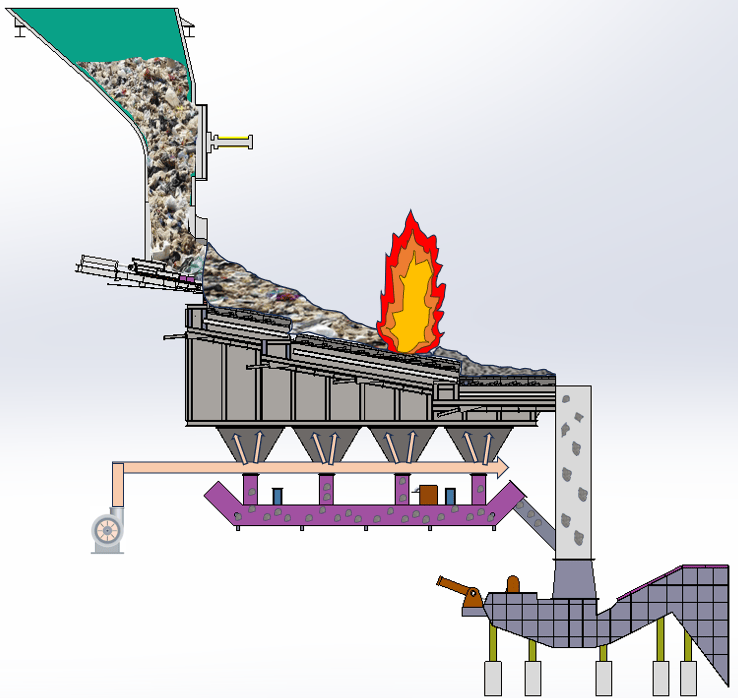
MSW has mixed contents (kitchen waste, plastics, paper, and so on) and high moisture content, and widely varying heating values. Through the alternating reciprocating motion of its moving and fixed grate bars, the reciprocating grate actively turns over and loosens the fuel bed, breaking up clumped waste and avoiding localized poor ventilation. At the same time, by adjusting the movement frequency it controls how long the waste stays in the furnace. Together with a high-temperature primary-air design, even low-heating-value, high-moisture waste can be fully dried and ignited and burn stably without strict pre-treatment.
- High combustion efficiency, serving both reduction and recovery
Along its length the grate is divided into a drying-and-ignition zone, a main combustion zone, and a burnout zone, with air supplied precisely to match the whole combustion process. The high-frequency movement of the main combustion zone intensifies fuel-air mixing, while the burnout zone slows down to ensure the fuel burns out completely, keeping the carbon content in the ash below 3%. Combustion efficiency is 15%–20% higher than with a conventional fixed grate. This efficient combustion maximizes heat recovery for power generation, cuts the waste volume by more than 80%, and holds the loss on ignition of the residue under 5% — meeting the twin goals of volume reduction and resource recovery.
- Excellent environmental performance with lower pollutant emissions
Following the “3T+E” combustion principle and combined with zoned independent air supply and a layered secondary-air system, it precisely controls the in-furnace temperature and oxygen concentration, ensuring a furnace temperature of ≥850°C and a flue-gas residence time of ≥2 seconds. This suppresses dioxin formation at the source while effectively cutting NOx and CO emissions. The modular design and precise combustion control also reduce the use of environmental consumables and ease the downstream flue-gas treatment burden, meeting strict environmental standards.
- Reliable operation with lower operation and maintenance costs
Hydraulic drive places the driving mechanism outside the grate, where the ambient temperature is low and wear is small, greatly improving reliability. The grate bars require no bolted connections, and the modular design allows direct replacement from above the grate, making installation and maintenance easy and extending the replacement cycle to more than 3 years while reducing unplanned downtime. The automated control system also enables full-process automatic operation, adjusting the feed rate, grate speed, and air supply to lower labor costs and running energy.